September 21, 2026 · 7 min
Water sampling for legionella: how a sample is taken so the result means something
Two hundred and sixty searches a month, and most of what decides the result happens before the bottle reaches the laboratory. Here is what a sample has to carry with it to be worth analyzing.
Two hundred and sixty searches a month, $9.96 a click, competition 0.53: the largest query in the pull we ran this week, and its two smaller forms, legionella sampling at 40 searches and $1.69, and legionella water sampling at 20, ask the same thing. How is the sample actually taken? The question deserves a plain answer, because the laboratory analyzes whatever arrives with the same care whether it was taken well or badly, and a badly taken sample produces a confident result about the wrong thing.
First draw or flushed: two different questions
A first draw sample is taken the moment the outlet is opened, without running it. It describes the water that has been standing in the fixture and the last length of pipe: the shower hose, the tap body, the branch behind the wall. A flushed sample is taken after the outlet has run long enough to draw from the main distribution, and it describes the system rather than the fixture. Neither is the correct sample. They answer different questions, and a plan that does not say which is wanted at each point leaves the choice to whoever is holding the bottle. We record the choice per sample and the report carries it, because a first draw and a flushed result from the same tap are not comparable.
The bottle, and what is already in it
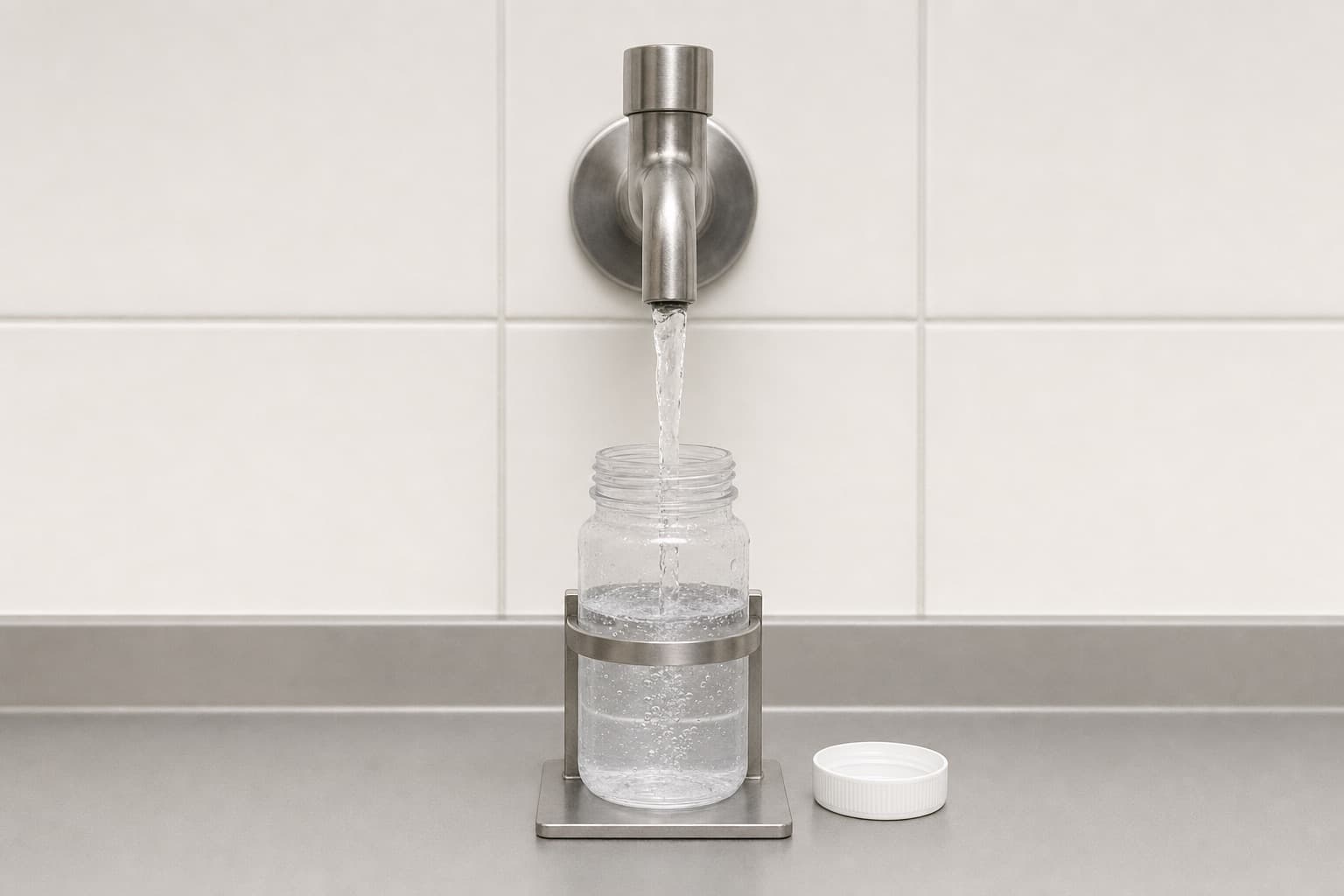
Sterile, obviously, and sealed until the moment of use. Less obviously, dosed with a neutralising agent. Most building water carries a disinfectant residual, and a sample without a neutraliser goes on disinfecting itself all the way to the laboratory. The count then describes the journey rather than the tap, and it flatters the system by exactly the amount the bottle kept killing. A bottle from a hardware store is the wrong bottle, and so is a laboratory bottle whose neutraliser was chosen for a different disinfectant than the one the building uses. That detail is settled when the round is planned, not on the day.
Measured at the tap, before the water is gone
Temperature, and the disinfectant residual, measured at the outlet at the moment of sampling and written on the record next to the sample identifier. These two readings are the context for the count. A result from an outlet whose hot water arrived cool, or whose residual was absent, is read differently from the same result at an outlet running as designed, and the difference is only available if someone measured it at the time. It cannot be reconstructed afterwards.
A label that lets the point be found again
Building, floor, room, fixture, first draw or flushed, date, time, sampler. A label that says third floor is not a point; it is a floor. The purpose of the label is not to tell the laboratory where the water came from, since the laboratory does not care. It is to let the next round go back to the same tap, so that two results can be compared. A sampling series is only a series if the points hold still, which is why choosing them is treated in where to sample in a building as the technical heart of the job.
The transport window
Samples travel cool, in the dark, and never frozen, and they have to arrive within the holding time the laboratory method allows. What that time is depends on the method and the laboratory, and it is on the laboratory to state it, not on the sampler to guess it. Past the window, the sample is still analyzed if the client insists, but the report has to say the window was exceeded, and a result with that note attached is worth less than the visit cost. We plan the round around the courier, not the other way about.
Chain of custody
A signed record of who held the samples from the tap to the bench: the sampler, the courier, the receiving technician, with times. It sounds bureaucratic until a result is disputed, at which point it is the only evidence that the bottle analyzed is the bottle taken. For a facility that may one day have to show an inspector, an insurer or an attorney what it measured and when, the chain of custody is part of the result. The full path from bottle to report is set out under sampling and analysis.
Who should take it
This is work for someone who does it routinely, and the reasons above are why. A facility that takes its own samples has to reproduce every step: the right bottle, the neutraliser matched to the disinfectant, the readings at the tap, the label, the window, the custody record. It is possible, and some large facilities do it well. What does not work is a kit that leaves the steps out, a trade-off examined in test kits versus laboratory culture. The sample is not the easy part of testing that precedes the hard part. It is most of the hard part.
What good sampling cannot rescue
A bad plan. A flawless sample from the wrong point measures the wrong point flawlessly. Technique protects the meaning of each result; the plan decides whether the results, taken together, describe the building. Both are ours to get right, and the second is where we start.
Have the samples taken by the people who analyze them
Bottle, neutraliser, readings at the tap, label, window, custody. We do all of it, every point.