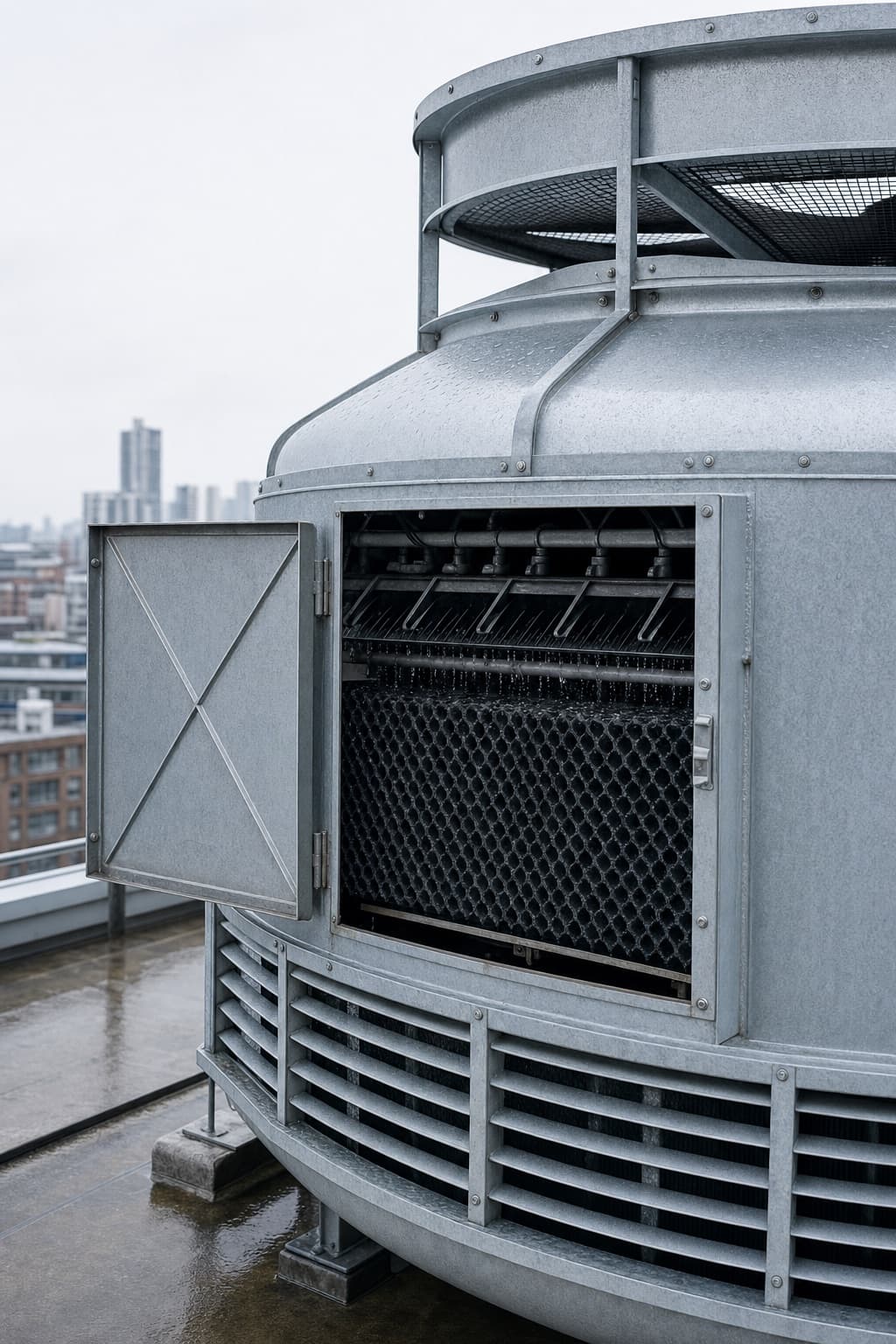
Cooling towers: the system with its own rules
Cooling towers are treated as a separate system in every programme, and in some jurisdictions they carry registration, treatment and testing requirements of their own. If your building has one, it is usually the first thing an authority will ask about.
Why towers are handled separately
A cooling tower is an open circuit: warm water is deliberately exposed to air to shed heat, which means aerosol is produced by design rather than by accident, and released outside the building where it is carried by wind.
That combination, warm water, aerosol, outdoor dispersion, is why towers attract specific attention, specific treatment regimes and, in some places, specific law.
Registration and specific rules
Some jurisdictions require cooling towers to be registered, maintained under a written plan, tested on a defined schedule, and reported on. Others have no tower-specific rule at all. The variation between states and cities on this single point is larger than on almost anything else in this subject.
The practical step: ask your local authority whether tower requirements apply at your address, and get the answer in writing. It is a short call and it changes the entire scope.
Treatment, and what testing verifies
Towers are almost always under a water treatment programme managed by a specialist contractor: biocide, scale and corrosion control, bleed and makeup, plus routine mechanical maintenance and cleaning.
Testing verifies that this programme is achieving what it is meant to achieve. That framing matters commercially: if the same contractor both runs the treatment and reports the verification, ask how independence is handled. It is not an accusation, it is a normal governance question with a normal answer.
- Who maintains the treatment, and what is recorded.
- Who takes verification samples, and whether that is the same party.
- What the response plan says, and who authorizes remedial action such as an emergency clean.
- Where the drift eliminator and mechanical condition sit in the inspection routine.
Seasonal operation
A tower shut down for winter and restarted in spring is one of the standard high-attention moments: stagnant water in a system designed to circulate, followed by a return to full operation.
Startup and shutdown procedures, cleaning and verification around those events are normally written into the plan. Where they are not, the plan is describing a tower that runs all year, which yours may not.
Frequently asked
Do we have to register our cooling tower?
In some jurisdictions yes, in others there is no such requirement. It is a local question with a definite answer. [Representative examples to be cited before publication.]
Our treatment contractor says testing is unnecessary.
That may be a defensible technical position, and it is also a position taken by the party whose work testing would verify. Where a requirement applies, it is not theirs to waive.
How often should towers be sampled?
According to the plan and any applicable local requirement, which for towers is more often prescribed than for domestic water systems. No frequency is published here.
Last reviewed July 29, 2026.
Related pages
- Water management programmesPut testing in its proper place, downstream of a programme.
- Commercial buildingsMap a building before designing a plan for it.
- Sampling and analysisSpecify sampling rather than accept whatever is offered.
- What drives the costCompare quotes that are not describing the same work.
Describe the towers
Number of towers, treatment arrangement, seasonal operation and whether local registration applies. That is the scope conversation for this system.
Legionella Screen samples building water systems and cooling towers and has the samples analysed by culture in an accredited laboratory. It does not diagnose illness, does not treat anyone, and gives no medical advice of any kind.