October 19, 2026 · 6 min
How legionella gets into building water, and why the supply is rarely the whole story
Low numbers of legionella can arrive with ordinary supply water. What decides whether that matters is what the building does with the water once it is inside.
“How does legionella get in water?” The question usually comes from somebody who has just been told that a building’s water is being looked at and wants to know where the bacteria could have come from. The short answer is unsatisfying but accurate: it is usually already there in small numbers, and the building decides the rest.
Legionella is an environmental organism
Legionella bacteria occur naturally in freshwater environments such as lakes and rivers, generally at low levels. Treated drinking water can carry small numbers of them into a building even when the utility is doing everything right. Their presence at the meter is not, on its own, a sign that anything has gone wrong.
This is why the question “where did it come from” tends to lead nowhere useful, and why guidance focuses instead on the conditions inside buildings that let the organism multiply.
What a building adds
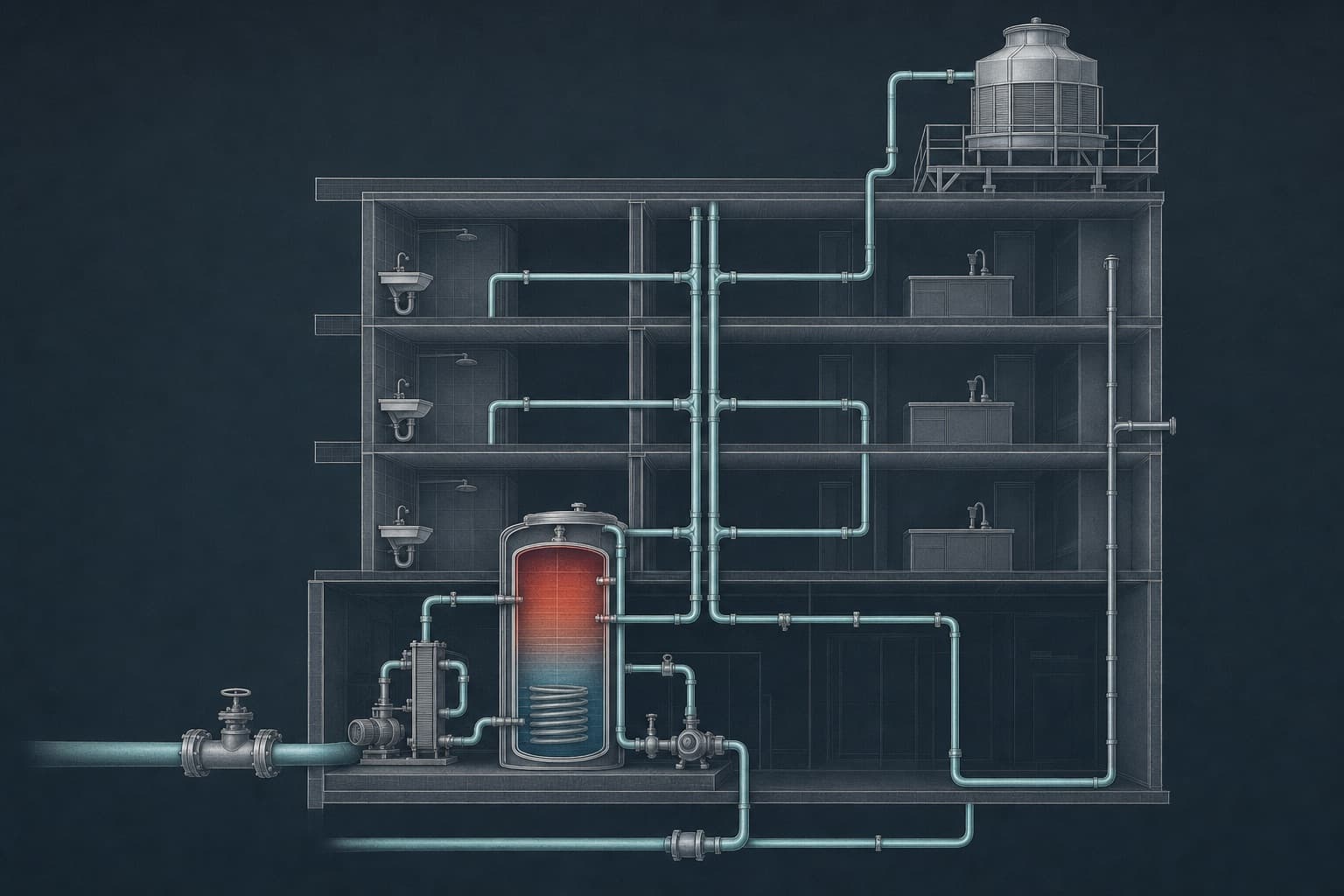
Building water systems can provide what open water usually does not: warm temperatures held for long periods, water that sits still, surfaces where biofilm develops, sediment in the bottom of tanks, and disinfectant residual that has decayed by the time water reaches the far end of a long run. Biofilm matters because it shelters bacteria and supports the small organisms legionella can grow inside.
The usual places it builds up
The pattern is consistent: storage, stagnation, warmth. Hot water storage tanks and heaters, recirculation loops that do not circulate well, outlets that are rarely used, and branches nobody uses at all. That last group is covered in dead legs in building plumbing. Cooling towers are a separate case, with their own warm water, sunlight and organic material, and with the ability to put droplets into the air. They are covered in cooling tower water treatment and legionella.
Events that change the picture
Some events are known to disturb building water: construction or repair work on the system, a water main break nearby, changes in supply pressure, and long periods of low use such as a building closed for weeks. They can loosen biofilm and sediment, change temperatures, or leave water standing. A program that names these events in advance, and says what will be done when one happens, is in a better position than one that reacts after the fact.
How it reaches people
Exposure is generally associated with breathing in small droplets of water, from showers, cooling towers, hot tubs, decorative fountains and similar sources, rather than with ordinary drinking. Anyone worried about their own health, or somebody else’s, should speak to a doctor. This site describes water systems only, and says so on every page that comes near the subject.
What a sample can and cannot tell you about the source
A positive result tells you that legionella was recovered from that sample, at that point, at that moment. It does not tell you where the bacteria entered the building, and it is not meant to. What a result carries is set out in what a legionella test tells you.
Where that leaves an owner
Since the supply cannot be made sterile, the practical lever is the building: knowing where water stores, stands and warms, and controlling those places. That is the whole logic of a water management program, and it is why programs start with a walk through the systems rather than with a test.
Start from the water you already have
The builder on this site walks through the systems in your building one by one, which is where the answer to this question actually sits.
Free to ask, no obligation.