August 1, 2026 · 7 min
Cooling tower water treatment and legionella: two programmes that have to agree
The chemistry programme and the legionella programme are usually run by different people to different targets. Where they disagree is where towers go wrong.
This query carries the highest cost per click in the category, at $18.29, and it is searched by people who already own a tower. It is worth answering carefully, because the usual answer conflates two things that are managed separately.
Two programmes, two purposes
The water treatment programme exists to protect the equipment and its efficiency: scale, corrosion, fouling. Its targets are conductivity, pH, inhibitor levels, cycles of concentration. It is usually run by a chemical supplier under a service contract.
The legionella programme exists to control a specific organism in a system that atomises water into the air. Its concerns are biofilm, sediment in the basin, dead areas with no flow, drift, and the condition of surfaces that a chemistry report says nothing about.
Both matter. They overlap in the biocide regime and nowhere else, and the overlap is where they are most often assumed to be the same thing.
Where they disagree in practice
- Cycles of concentration. Running a tower harder saves water and chemicals. It also concentrates nutrients and solids in the basin. The efficiency target and the biological target pull in opposite directions, and somebody has to decide.
- Biocide regime. Oxidising and non-oxidising biocides behave differently against biofilm, and a regime tuned to keep a chemistry report clean is not automatically a regime that penetrates biofilm on a fill pack.
- Cleaning intervals. Chemistry does not remove sediment from a basin. A physical clean does, and it is the single most effective thing that gets deferred. What it changes on a laboratory report is covered in what a clean changes in a result.
- Idle periods. A tower off for a season is not a tower being treated. The chemistry contract usually pauses; the biology does not.
What a chemistry report cannot tell you
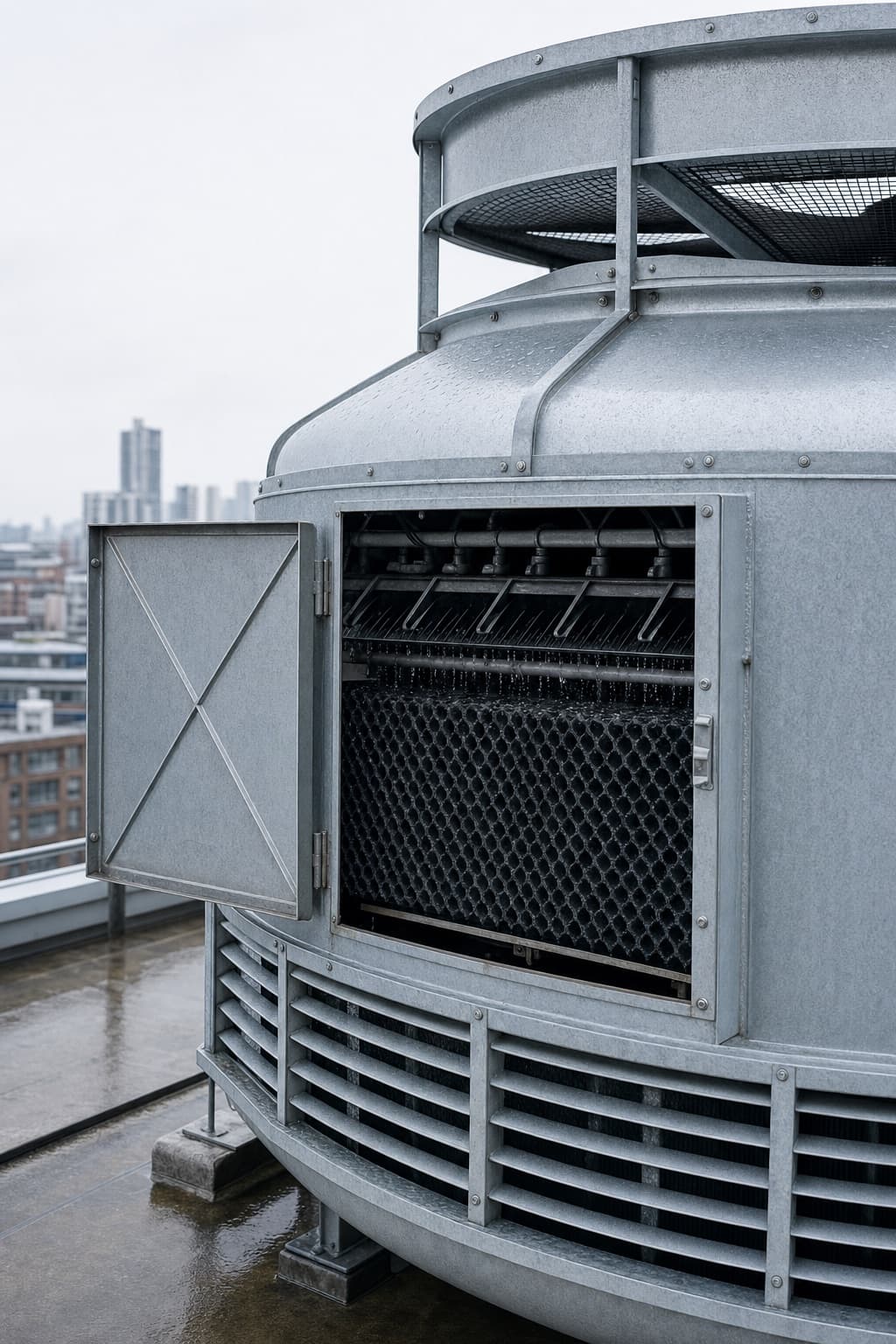
Whether there is biofilm on the fill. Whether the drift eliminators are intact. Whether there is a decimetre of sediment in the basin. Whether a section of the distribution deck has stopped flowing. All four are visual findings, all four matter more than the conductivity reading, and all four require somebody to open the tower and look.
That inspection is described under cooling tower testing.
Why we do not sell chemicals
Because the company that supplies the treatment programme has a structural reason to conclude that the answer is more treatment, and the company that samples has a structural reason to conclude that it is not. Separating those two roles is the cheapest governance improvement available on a tower, and the same separation decides who verifies a physical clean, as set out in buying and verifying a tower clean. It is why we sample and report and do nothing else.
Where this is set locally, and increasingly so
Several jurisdictions now impose registration, mandatory management plans of the kind described in what a water management plan contains, defined sampling frequencies and reporting for cooling towers, and the requirements differ substantially between them. Which apply to your tower has a local answer, and it is established before a sampling programme is designed rather than after.
Have the tower sampled against its own programme
We sample and report. We sell no chemicals, so we have no reason to find a dosing problem.
Legionella Screen samples building water systems and cooling towers and has the samples analysed by culture in an accredited laboratory. It does not diagnose illness, does not treat anyone, and gives no medical advice of any kind.