September 16, 2026 · 6 min
Cooling tower basin cleaning: what sits at the bottom, and how to measure it
What collects at the bottom of a cooling tower basin, why it matters for legionella, and how sampling before and after a clean shows what the work changed.
Basin cleaning is a small, specialized subject, and the people who ask about it usually have an urgent reason: a result they did not like, or a tower that has not been opened in a long time. This page is about measuring what is in a basin, before and after the cleaner has been.
Why the basin, of all components
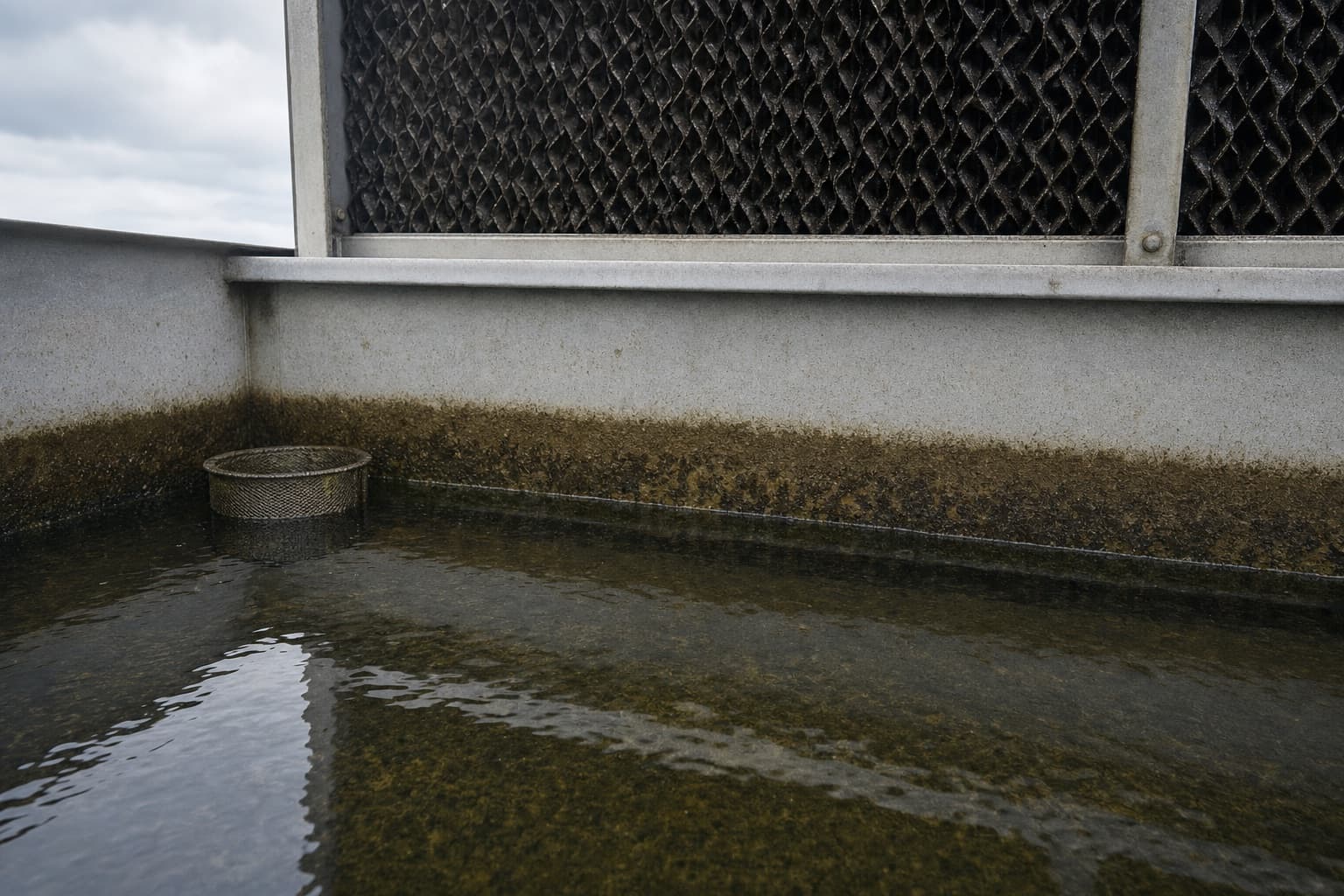
It is the lowest point of the circuit. Everything the air scrubs into the water, and everything that settles out of it, ends up there: dust, scale fragments, organic matter, sludge in the corners where flow dies. The basin is also warm, open to light at the louvres, and permanently wet, including the band above the waterline where deposits and biofilm sit half out of the water. The photograph on this page is of exactly that band. None of this is a defect; it is what the component is for. A tower is a machine for washing air with water, and the basin is where the washing collects.
What sediment means for a result
Sediment is shelter. A circulating biocide, of the kinds compared in cooling tower cleaning chemicals, treats the water column, and the interior of a sediment layer is not the water column. A tower can hold an acceptable chemistry report and a loaded basin at the same time, which is why a sampling plan for a tower treats the basin as its own point rather than assuming the sump says what the deck says. How those points are chosen is part of cooling tower testing.
What a basin clean involves, in the cleaner’s trade
Draining or isolating, mechanical removal of sediment, often by vacuum, scrubbing of the walls and the waterline band, attention to the sump and strainer, then disinfection and rinse before refill. How to buy that work, and how to check it afterwards, is set out in buying and verifying a tower clean. Some contractors offer vacuum cleaning of a basin with the tower still in service; whether that is acceptable for a given tower is a question for the program and the contractor, not for this page. The concern here is narrower: what the basin contained before, and what grows after.
The before sample, and why it is skipped
A clean is usually booked because someone has already decided the basin is dirty, and at that moment a baseline sample feels like paying to confirm the obvious. It is not. It is the only number the post-clean result can ever be compared against, and it sometimes carries its own surprise: a visibly dirty basin with modest growth, or the reverse. Judgment by eye runs in both directions, and both directions are wrong often enough to measure instead. The baseline also prices honestly: it is one more round on a visit already being scheduled, not a separate mobilisation.
The after sample, and when
Not during the works, and not from water still carrying the disinfection. After the tower is refilled and back at stable operation, from the same points, by the same method, through the same laboratory, as set out under sampling and analysis. The pair of results is the deliverable the cleaning invoice cannot provide, and the general argument for the pair is made in what cleaning changes in a result.
A clean basin is not a finished job
The basin refills with sediment because the tower keeps scrubbing air. What controls the rate is the ongoing regime: filtration where fitted, blowdown, treatment, and inspection on a schedule. A basin clean belongs inside that schedule as a maintenance event with a date, an owner and a verification, not as an emergency purchased at whatever the day demands. Plenty of basin cleaning is bought exactly that way.
Whether basin cleaning is required
In some jurisdictions, cooling towers carry registration, maintenance and cleanliness obligations, and inspection findings about basins can have regulatory weight. Whether that applies to your tower depends on where it stands and who regulates it, and the answer belongs in the water management program before it is needed. We will not state it as a universal rule, because it is not one. The sources of those rules are in what cooling tower testing requires.
Sample the basin before anybody touches it
The baseline is the cheapest part of a clean and the first thing skipped.
Free to ask, no obligation.